






Education and Research system

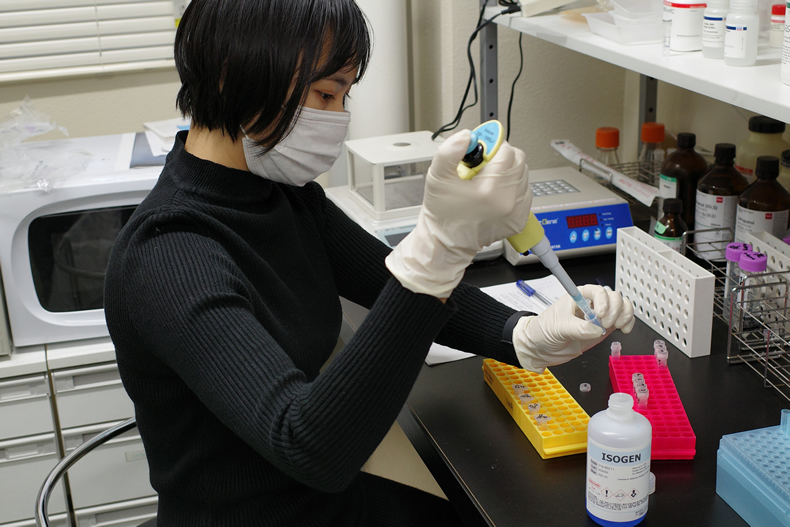
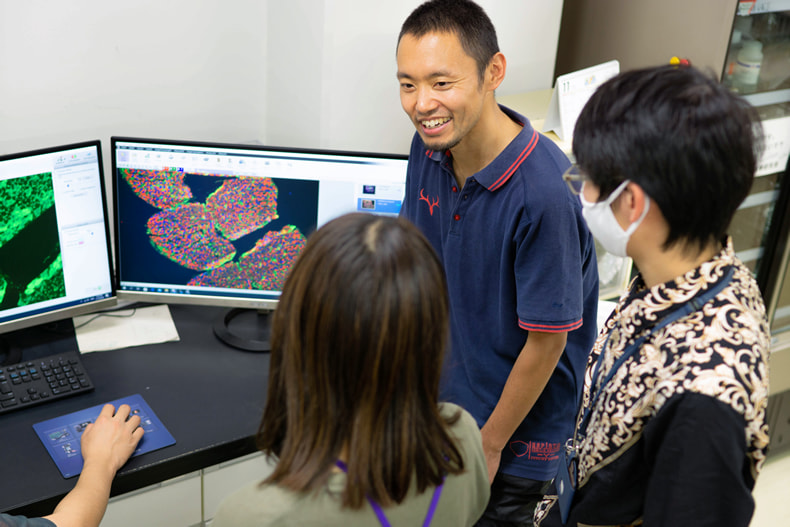
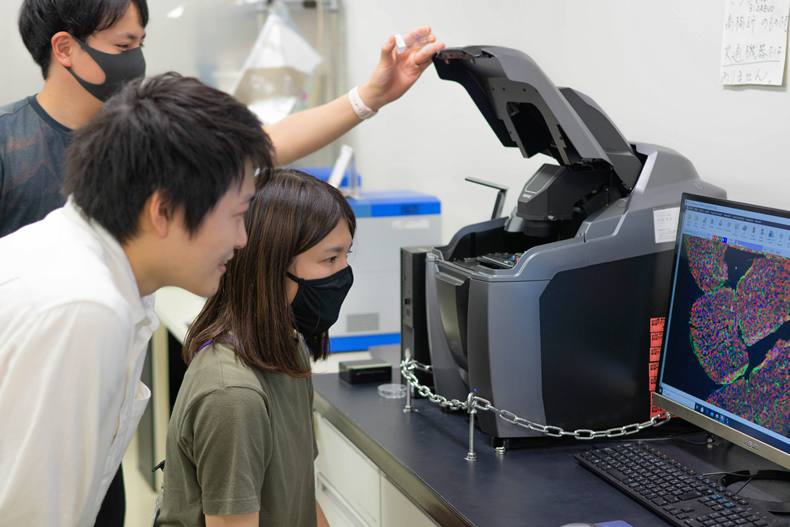
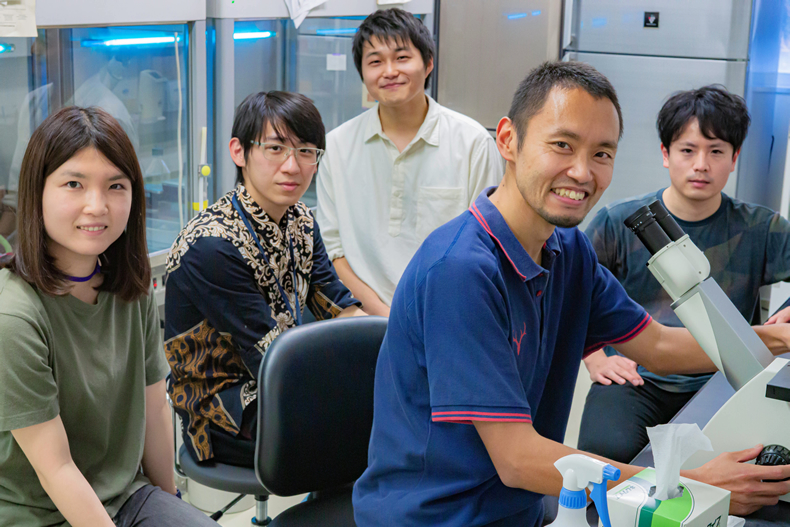
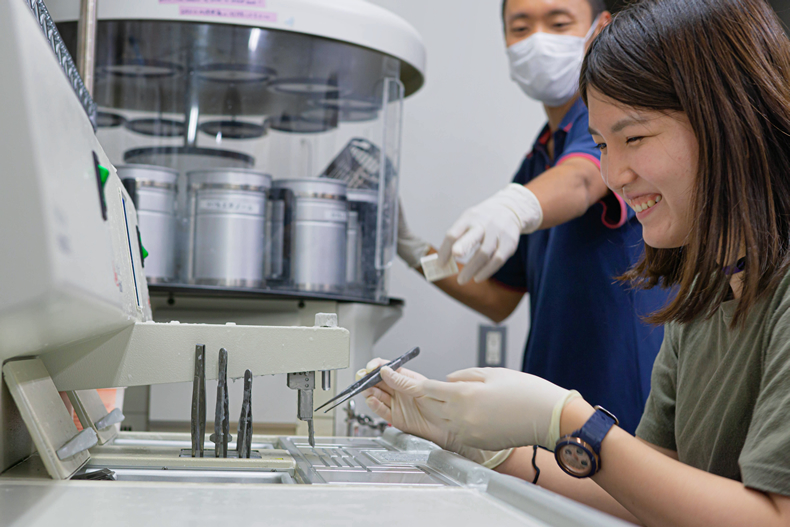
HBP students engage in a research lab rotation as part of "Basic Experiments in Human Biology" for a month and a half in spring or autumn.
HBP Required Course
Basic Experiments in Human Biology
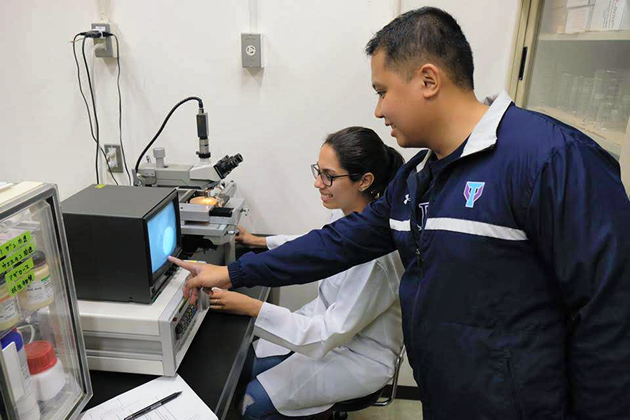
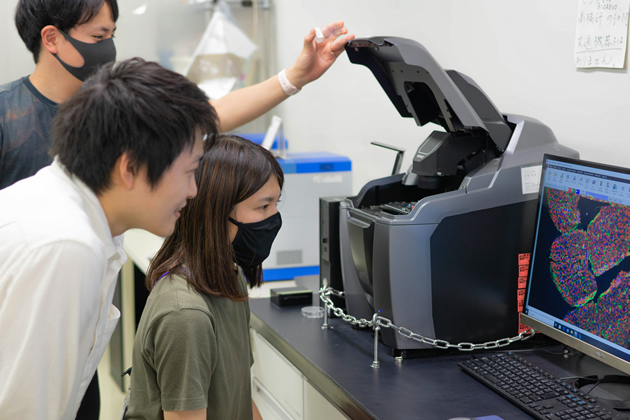
The students learn the outline of each research and basic experimental methods/research concepts and perform elementary experiments/simulation at research laboratories headed by program professors.
Professor Kenji Irie
You can often find a fascinating research world even in the laboratories you work every day. We know that moving forward as soon as possible is a habit of us, all human beings. However, in our program, we encourage our students to make a side trip and get exposed to the world they never knew by offering the course, 'Basic Experiments in Human Biology'.
In this course, the first-year students work in the four different laboratories for one week each. While someone who is fully occupied by bacteriology may find a new aspect of biology from mathematical approach, another one living in the computer-oriented world might be dissecting mice at laboratory. Such startling experiences can open a door to the new world. Knowing something different can be an incentive to establish individual.
The university is a treasure chest. You may find a key to self-actualization in the world you have never been interested in.
| Laboratory | Experimental methods that can be learned |
|---|---|
| Irie Lab | Yeast genetics and molecular biology, Gene knockout, Regulation of gene expression, GFP imaging, Yeast two-hybrid |
| Kawaguchi Lab | Protein analysis, cell biology etc. |
| Fukamizu Lab | Genetics of C. elegans, analytical biochemistry |
| Takahashi Lab | mouse experiment, molecular biology experiment, histological analysis |
| Ohneda Lab | Stem cell analyses, Gene analyses |
| Hiromi Yanagisawa Lab | immunostaining, mouse dissection, western blot, micro dissection system, imaging by confocal microscope |
| Masashi Yanagisawa Lab | EEG/EMG based sleep recording, Fluorescence live cell imaging |
| Kato Lab | Cell culture, cell migration, immunohistochemistry, Western blotting/td> |
| Sakurai Lab | basic programming, basic data analysis, basic machine learning, numerical computation |
| Shibuya Lab | Flow cytometry, antibody purification, tissue culture, animal experiments with disease models |
| Chiba Lab | primary culture, imaging, etc |
| Sakaguchi Lab | In vivo imaging in freely-moving mice; Optogenetic manipulation of neuronal activity; Sleep and Memory analysis |
What was particularly impressive about the lab rotations was not only the technology that each lab possessed, but also the completely different atmosphere of the lab itself. It was a very enjoyable experience because you can learn about the technology to a certain extent from the papers, but you can never know the atmosphere unless you actually go there.
Wakimoto Arata
I had clear purposes of the lab rotation, that is to experience to use many kinds of experimental animals and to know about non-research aspects such as creating an atmosphere and rules necessary for having one's own laboratory in my future. During this period, I had a very fulfilling period with one laboratory that I attended for three weeks or that I conducted experiments for figures of my paper. It is not easy to adjust the time with my own experiment and I have experimented until midnight during this period, but I feel that I have grown by overcoming it. I'm thinking about long-term overseas lab rotation, so I think I was able to do a good simulation for that.
藤野三法
I observed cellular responses to growth factor stimuli through a fluorescence microscope and entire biological responses of genetically modified nematodes to temperature stress. From this experience, I became more interested in the issues concerning the relations between life and environment. I believe that I can apply the new aspects and approaches I learnt to my own research.
L.Sha
I was able to spend a valuable time while engaging in the laboratories of a variety of fields. I was able to gain knowledge and techniques outside of my field and get to know faculty members who worked together in the laboratories.
Y.Miura
The teachers and senior students told me not only the research projects but also the equipments and protocols. It is very good opportunity to think how I can advance my research project using different approaches.
Ayana Iijima
For the curious ones, Lab Rotation is such a wonderful opportunity to explore different approaches in scientific study. From the fundamental research on yeast where famous autophagy was discovered up to the translational research on animal study. Please take a good use of this opportunity to explore your motivation and passion in research.
Chandra Louis
I have expanded my academic perspective through learning immunology, yeast research, bioinformatics, and embryology from the basic to the experimental level from the faculty members in a short period of time. I found it exciting that all the techniques being used conventionally in other research fields can be applied to my research.
M.Hashimoto
I was able to deepen my interest and insight through the experimental studies in which I engaged using other model organism than mice that I normally use in my laboratory, such as yeast and nematodes. Those experiments in different fields enabled me to penetrate insight to my research from different angles.
T.Kikuchi
We could have a wide persupective, not focusing on one thing too much. Also we could get acquainted with professor/seniors who are working in different fields from us, they advised my research from the different view. That were very good opportunities.
後藤のはら
Stepping out of the comfort zone and learning knowledge of different fields helped me know my drawbacks and strengths and the lab rotation is such a chance. Discussing with the professors and lab members about what to do but not just following their ongoing projects, I used the rotation as an opportunity to learn experiments that I cannot do in my own lab. Also, the techniques learnt from other labs gave me alternative ways to leverage the knowledge and experience which can even be used to delve deeper into my own study field.
Wenxin Lyu
During my lab rotation, I extracted proteins from cancer cells, took the skin off laboratory mice, and solved eigenvalue problems. Those experiments were quite shocking to me who merely handle bacteria. This invaluable experience broadened my perspectives of my research.
A.Takemura